Small lots can inherit big risks. Learn how flooding, drainage, and subdivision design affect housing-scheme properties.
Why Small Lots Still Need Big Due Diligence
#### How LandSentry helps Jamaican housing-scheme buyers understand drainage, flooding, slope and subdivision-scale risk before they buy
Core message: Natural hazards do not stop at a 1/4-acre boundary. A small housing-scheme lot can inherit risk from the whole subdivision: roads, gullies, slopes, drains, fill, common infrastructure and upstream runoff.
---
A small lot can still sit in a large hazard system
A quarter-acre lot can feel “small enough to be simple.” In a typical Jamaican housing scheme, the buyer may assume that because the roads, drains, lots, sidewalks and house pads were laid out by a developer, the risk has already been solved.
That assumption can be expensive.
Natural hazards do not stop at lot boundaries.
- Floodwater does not care that your parcel is only 1/8 acre.
- Storm runoff does not follow a sales brochure.
- Landslide risk does not disappear because a house is in a planned community.
That is why LandSentry’s LIFT™ and CLEAR™ products are not only for large acreage, farms, villas or development land. They are also valuable for small residential lots, townhouses and homes in housing schemes, especially when the buyer lives overseas and cannot easily read the land for themselves.
---
The mistake: judging only the house, not the whole subdivision
Most home buyers focus on the building:
Those things matter.
But in a subdivision, the performance of your individual lot depends heavily on the entire subdivision parcel.
A house may be fine, but the subdivision layout may push stormwater toward one corner.
That means a buyer should not only ask, “Is this house good?”
The better question is: Where does this lot sit inside the drainage, slope, access and hazard system of the entire scheme?
That is the LandSentry advantage.
---
Caribbean context: flooding is often a drainage-system problem
Most countries’ public disaster guidance identifies several main causes of flooding, including:
They also note that flooding is a natural feature of drainage systems and rivers and streams.
For a housing-scheme buyer, this is critical.
Flood risk is not only about whether a river is nearby.
It may be about where stormwater goes after intense rainfall hits:
The more land is paved or roofed, the faster runoff moves.
If the drains are undersized, blocked, poorly graded or discharging through the wrong route, the low lots receive the consequence.
This is why a whole-subdivision analysis can be more valuable than a narrow lot-only review.
A buyer does not need a 10-acre estate to benefit from GIS, drainage mapping and hazard screening.
A 1/4-acre lot may be exactly where precision matters most.
---
Jamaican example: OceanPointe, Hanover
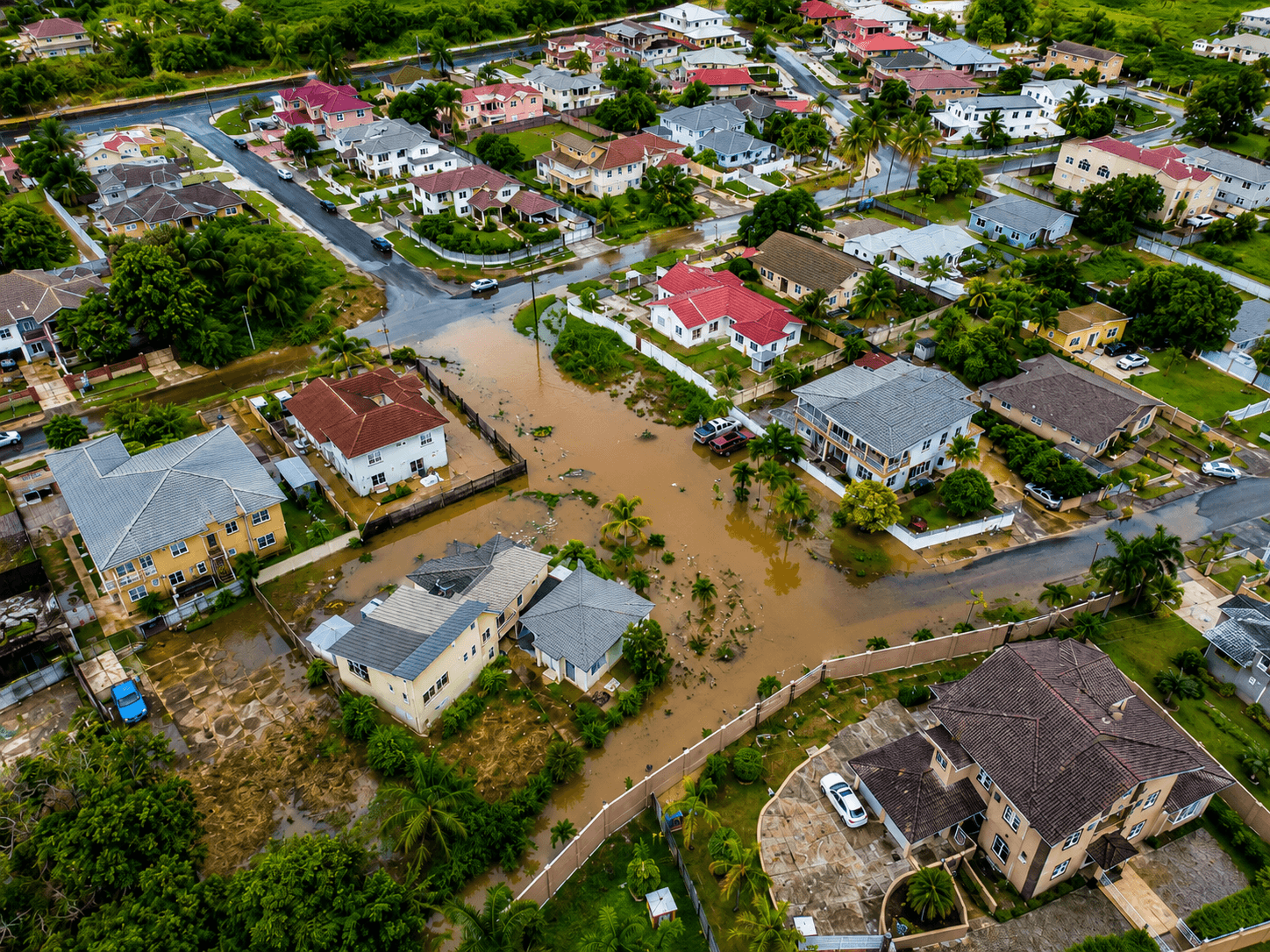
A recent Jamaican example is the flooding at the OceanPointe Housing Development in Hanover.
The Jamaica Gleaner reported that flooding in Phase Five and Phase Six left several homes submerged, with at least five homes sustaining significant damage to furniture, household items and infrastructure.
Television and social media reports also described residents at Ocean Point/OceanPointe as traumatised after severe flooding.
The planning lesson is powerful: in a housing development, the buyer’s risk may not be obvious from the front elevation of the house.
The critical information may be in the:
A LandSentry review would not guarantee that a property will never flood.
But it could help a buyer ask the right questions before purchase:
---
What LandSentry would analyze for a small lot
For a small residential parcel, LandSentry’s value is not that the lot is physically large.
The value is that the lot is part of a larger physical system.
Subdivision position
Is the lot at the high point, midpoint or low point of the scheme?
A house near the low end of a subdivision may collect water from roads and upstream lots.
Drainage pathways
Where does stormwater likely flow during heavy rainfall?
Roads often become temporary drains.
A lot at an intersection, bend, cul-de-sac low point or road sag may be more exposed.
Nearby gullies and channels
Is the property beside a formal drain, natural gully, culvert, stormwater outlet or filled channel?
These features may be dry during a showing but active during storms.
Slope and retaining walls
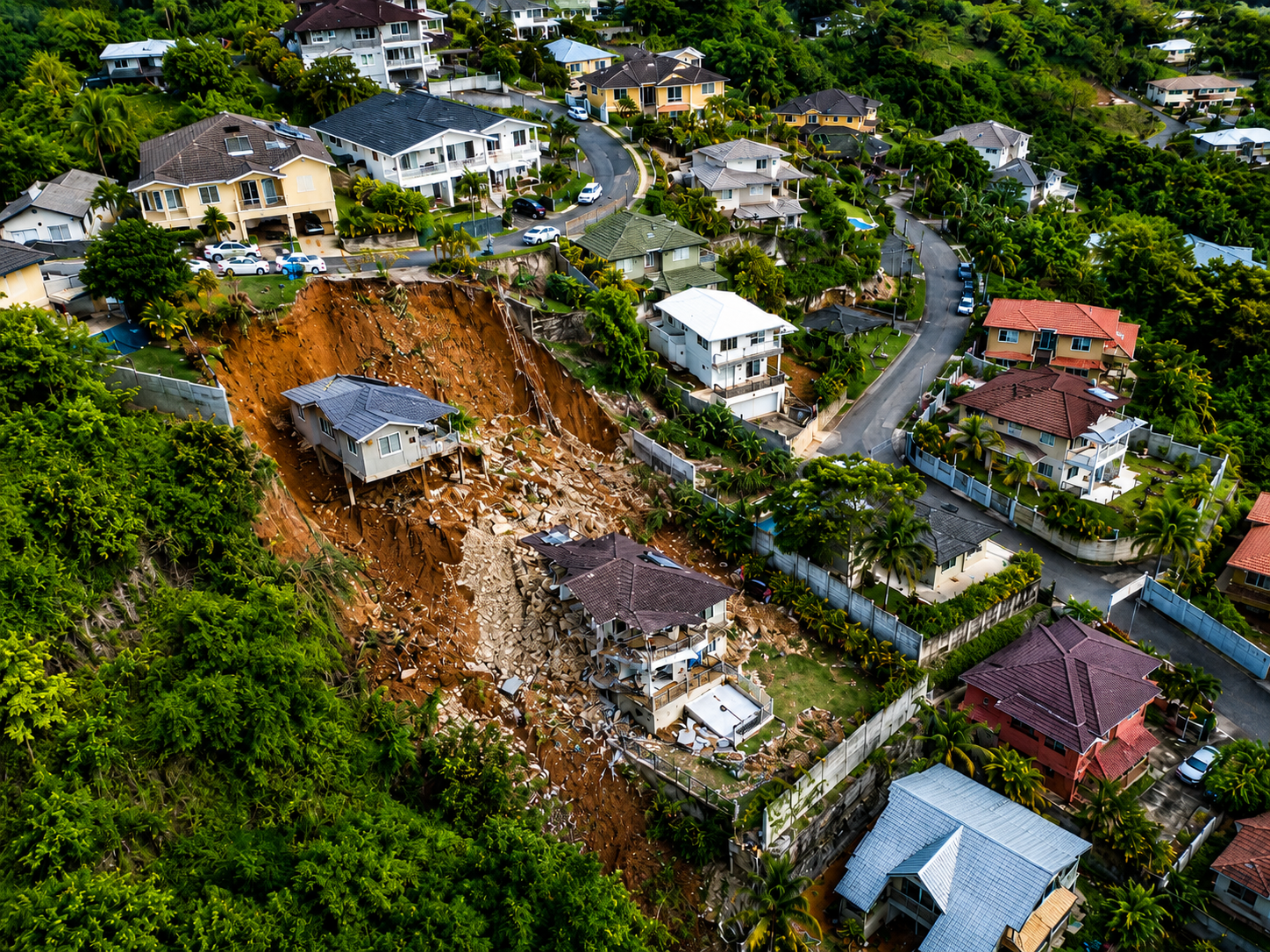
Even in housing schemes, some lots are cut into hillsides or filled along slopes.
Retaining walls, cracked pavement, leaning fences or steep backyards can indicate future repair exposure.
Flood-prone access
The house itself may stay dry while the access road floods.
That still matters for:
Coastal and hurricane exposure
In coastal schemes, drainage combines with:
Even where storm surge is not the main issue, blocked drainage during a hurricane can create severe local flooding.
Fill and ground settlement
Some subdivisions are built on:
Buyers should know whether there are settlement cracks, poor compaction clues or ponding patterns.
Offsite contributors
The source of the problem may be outside the scheme:
---
How drainage maps help buyers select lots
Drainage mapping is one of the clearest examples of why LandSentry pays off for small lots.
Imagine a scheme where the houses are priced similarly.
Lot A, Lot B and Lot C may all be 1/4 acre.
The houses may look almost identical.
But a drainage analysis may show that:
The buyer looking only at the house might choose based on kitchen finishes or paint color.
The buyer using LandSentry might choose the lot with lower long-term risk — or negotiate a lower price for a higher-risk lot.
That can save money in several ways:
---
Other LandSentry use cases for housing-scheme buyers
Choosing between lots in the same development
A developer or realtor may show several homes in the same scheme.
LandSentry can compare them by:
The “best” lot may not be the newest or prettiest; it may be the one with the safest physical setting.
Checking a resale home before offer
For an existing scheme home, LandSentry can review:
A buyer can then ask the seller targeted questions:
Avoiding the “cheap lot” trap
Sometimes the lowest-priced lot is low for a reason.
It may sit:
A LandSentry review can help determine whether the discount is a bargain or a warning.
Protecting mortgage and insurance decisions
Extreme weather affects housing markets.
Research on Jamaica’s housing market has examined how extreme rainfall and hurricanes affect real estate and housing finance, reinforcing why buyers should understand hazard exposure before committing to a purchase.
Understanding common-area risk
In schemes, common drains, culverts, gullies, entrances, boundary walls and detention areas may affect everyone.
A buyer should know whether:
The home may be private, but the hazard system is shared.
Supporting negotiation
LandSentry findings can provide negotiation leverage.
If the lot:
the buyer can request:
---
Why this matters especially for diaspora buyers
Many diaspora buyers are trying to purchase from abroad.
They may see:
But those rarely show the property during heavy rainfall.
They rarely show:
LandSentry helps close that information gap.
A diaspora buyer can send:
LandSentry can then review the lot in context, not isolation.
That gives the buyer a clearer basis to proceed, pause, renegotiate or request specialist review.
---
LIFT™ vs CLEAR™ for small lots
LIFT™
For a small housing-scheme lot, LIFT™ is the practical first step.
It is a desktop screen that can review:
CLEAR™
CLEAR™ is appropriate where the purchase decision needs stronger verification.
That may include:
The point is not to overcomplicate a small purchase. The point is to match the review to the risk.
A low-risk flat urban lot may only need a light screen.
A low-lying coastal lot, hillside scheme lot, gully-adjacent lot or repeatedly flooded community may justify a deeper review.
---
The return on investment
The cost of due diligence is small compared with the potential cost of choosing the wrong lot.
A flooded house can mean:
A lot with hidden drainage or slope risk may require:
For a buyer, the best return is often not dramatic.
It is quiet confidence:
---
The LandSentry message
Small lots still deserve serious due diligence because natural hazards operate at the subdivision scale.
In Jamaica, a housing-scheme home is not just a structure; it is part of a drainage basin, road network, slope system and community infrastructure pattern.
Before buying a house in a Jamaican housing scheme, do not only ask whether the title is clean and the kitchen is nice.
Ask:
LandSentry helps buyers answer those questions before they commit.
Before you buy
Send LandSentry:
Start with LIFT™ for a fast risk screen.
Use CLEAR™ when drainage, flooding, slope, access or subdivision layout could determine whether the home is a smart purchase or an expensive surprise.